

Clear Quran recitation does not come from speed. It develops through careful articulation, steady repetition, and correction of small mistakes. Quran pronunciation correction starts with forming each Arabic letter at its proper articulation point, then applying Tajweed rules as you recite. Listening closely and receiving focused feedback can help you identify what needs work.
It’s natural to want every sound to be clear when reciting the Quran, but some letters and rules take time to become familiar. A gentle, consistent approach can make learning feel more manageable: focus on one sound at a time, listen to a clear recitation, then repeat and review your own.
This guide explains how to improve pronunciation, understand makharij, recognize common beginner errors, and apply Idghaam. It also shows how online practice can support your progress through recordings, audio exercises, and teacher feedback, helping you approach each step with care and confidence.
Key Takeaways
- Build clearer recitation by slowing down and repeating short passages, giving careful attention to each sound and Tajweed rule.
- Learn the makharij, or articulation points, so you can distinguish Arabic letters that may sound similar.
- Notice common beginner slips, including when Hamzat al-Wasl is pronounced, and practise correcting them in context.
- Use the Idghaam rules to guide how letters join during recitation rather than treating each sound in isolation.
- Record your recitation, compare it with a careful model, and use online teacher feedback to identify what to practise next.
1. How to Improve Quran Pronunciation and Recitation?
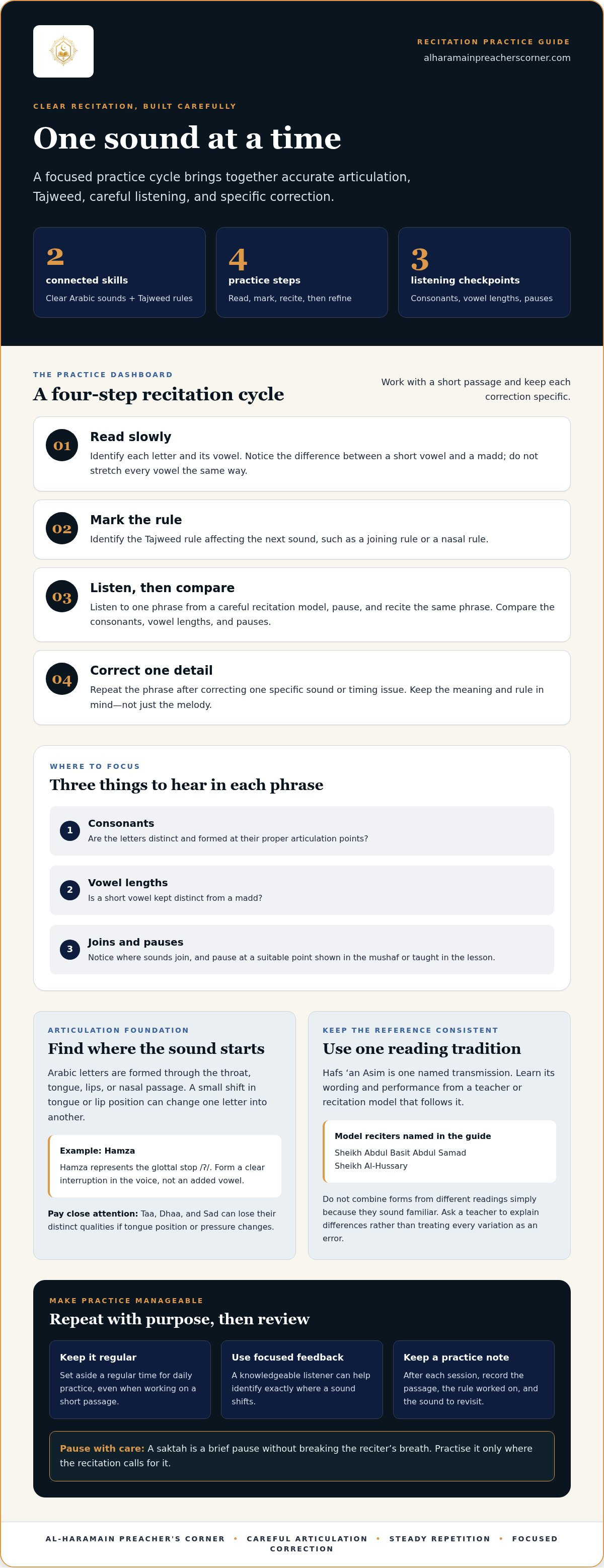
Accurate recitation depends on two connected skills: forming Arabic sounds clearly and applying Tajweed rules. Start with a short passage, then listen for letter sounds, vowel length, and where sounds join. For example, distinguish a short vowel from a madd instead of stretching every vowel the same way. This focused approach gives each correction a clear place in your recitation.
Choose a consistent reading tradition before working through pronunciation details. Hafs ‘an Asim is one named transmission; learn its wording and performance from a teacher or recitation model that follows it. Don’t combine forms from different readings simply because they sound familiar. If your mushaf or lesson identifies a reading, use it as your reference. Ask your teacher to explain differences rather than treating every variation as an error.
Use a listen-and-repeat routine to put Tajweed into practice. Sheikh Abdul Basit Abdul Samad and Sheikh Al-Hussary are examples of skilled reciters whose recordings learners can follow. Choose a short passage, listen to one phrase, pause, and recite the same phrase. Compare the consonants, vowel lengths, and pauses. Then repeat the passage while keeping the meaning and rule in mind, rather than simply imitating the melody.
During practice, work through these steps in order:
- Read the passage slowly, identifying each letter and its vowel.
- Mark the tajweed rule that affects the next sound, such as a joining or nasal rule.
- Recite one phrase aloud, then compare it with the chosen model.
- Repeat the phrase after correcting one specific sound or timing issue.
Pausing also shapes clear recitation. Stop at a suitable point shown in your mushaf or taught in your lesson, and avoid cutting off a word in a way that obscures its meaning. A saktah is a brief pause made without breaking the reciter’s breath, unlike a full stop. Practise it only where the recitation calls for it, rather than inserting pauses wherever you need to breathe.
How often should you take lessons or practise? Set aside a regular time for daily practice, even if you focus on a short passage. Take lessons often enough to receive correction, then apply each lesson’s specific guidance in your own recitation.
After each session, keep a simple practice note: write down the passage, the rule you worked on, and the sound to revisit. This makes Quran pronunciation correction more focused, so you can begin the next session with a clear task instead of a vague goal to improve.
2. Arabic letter articulation and makharij
Each Arabic letter has an articulation point, or makhraj, that shapes its sound. In Quran recitation, a small shift in tongue or lip position can change one letter into another. Hamza represents the glottal stop /ʔ/, while other letters are formed through the throat, tongue, lips, or nasal passage. Learning these positions gives you a practical foundation for clearer recitation.
Begin by listening for where a sound starts, rather than focusing only on its written form. For example, pronounce hamza with a clear interruption in the voice, not as an added vowel. Then compare it with a letter formed farther forward in the mouth. A teacher or clear demonstration can help you notice whether your tongue, lips, or throat are doing the work.
Some letters need particularly careful articulation. Taa, Dhaa, and Sad can lose their distinct qualities if your tongue position or pressure changes. Practise each in a short syllable, then use it in a Quranic word. Say the word slowly, listen for the target letter, and repeat it in the full phrase without exaggerating the sound.
Educational videos about Arabic letters can show how the mouth moves at each articulation point. Watch one example at a time, then pause and imitate the speaker. Use a mirror to observe whether your lips close or round as expected, but remember that visible movement cannot show every tongue position. Listening is still essential.
Try this sequence with one letter that feels difficult:
- Listen to a careful model and identify the letter’s starting position.
- Repeat the sound alone, keeping the rest of the mouth relaxed.
- Practise the letter with its vowel, then within a short word.
- Recite the word in context and notice whether the sound stays distinct.
For example, compare Sad with a lighter “s” sound. Keep its characteristic fullness without pressing so hard that the sound becomes strained. Ask a knowledgeable listener to identify exactly where your sound shifts, then return to that position and repeat the word. This focused feedback is more useful than repeating a whole passage without knowing which letter needs attention.
Arabic language learning can also strengthen your familiarity with letter forms and sounds. If you want guided practice alongside recitation, explore Arabic and English language learning as a way to build that foundation. Keep your practice focused: one letter, one position, and one clear example at a time.
3. Common beginner pronunciation mistakes
Beginners often confuse a letter’s written shape with its sound. Your mouth still needs to form each letter according to its own characteristics. For example, a learner may soften a full-sounding letter or add too much pressure to a light one. Compare the sound in a short word, then listen for it within a complete Quranic phrase. This can reveal whether the difficulty lies in the letter itself or in joining it to the next sound.
Hamzat al-Wasl is another frequent source of confusion. Pronounce it when its word begins a phrase or follows a pause, but not when the recitation connects from the preceding word. Practise both contexts using an example from your current passage. First begin at the word, then recite continuously from the word before it. This contrast helps you avoid adding the initial sound when it should not be heard.
Vowel timing can also drift during recitation. A short vowel may be stretched, or a long vowel cut short, especially when you try to keep pace with a recording. Choose a phrase and listen for the vowel being practised. Recite it slowly, then at a natural pace. Keep the sound steady instead of adding an extra vowel after a consonant that should close cleanly.
Use these checks when reviewing a passage:
- Circle a letter you repeatedly pronounce differently from the model.
- Mark whether its vowel is short or extended in that word.
- Listen for an added sound between connected words.
- Repeat the phrase without changing its rhythm or inserting an unneeded pause.
Another common mistake is focusing on melody before accuracy. A pleasing tune cannot replace clear letters or careful Tajweed. Sheikh Al-Hussary’s measured recitation can help you hear how sounds remain distinct in a flowing phrase. Listen to a short section, then imitate its articulation without copying a pitch that feels unnatural. Tajweed is about precise recitation, so let the rule guide the sound rather than allowing melody to reshape it.
Correct mistakes one at a time. If a listener points out a sound, return to that word, isolate the letter, and recite it in context again. Avoid changing several sounds at once, or you may lose track of which adjustment helped. A simple note about the passage and correction keeps your next practice focused. Patient review turns a repeated slip into a clear, manageable lesson.
4. Idghaam rules and examples
Idghaam means merging one sound into the letter that follows instead of pronouncing both separately. In the rules of noon saakinah and tanween, it applies when either is followed by a particular letter. The six letters are ya, ra, meem, lam, waw, and noon. Learn to recognize the written cue first, then listen for how the recitation connects the sounds.
The six letters fall into two groups. Ya, noon, meem, and waw are read with ghunnah, a nasal resonance. Lam and ra are read without ghunnah. For example, in man yaquulu, the noon sound merges into ya with nasal resonance. In min rabbihim, the noon merges into ra without it. These examples help you hear the distinction instead of relying on a memorized list alone.
Tanween can trigger the same rule. In hudan lil-muttaqin, the tanween before lam joins the next sound without ghunnah. Read the phrase smoothly, but don’t erase the next letter or add a vowel between the sounds. The aim is clear, connected recitation that follows the rule, not rushed blending that makes the words hard to recognize.
Practise Idghaam with this sequence:
- Find noon saakinah or tanween at the end of a word.
- Look at the first letter of the next word and check whether it is one of the six Idghaam letters.
- Identify whether the next letter calls for ghunnah or no ghunnah.
- Recite the two words together, then listen again for a smooth connection and a distinct following letter.
Don’t apply this rule just because two words touch. The following letter determines whether Idghaam occurs, while other Tajweed rules apply to different letter combinations. In a lesson, a teacher can point out the written cue and model the sound, helping you connect the rule’s name with how it is recited.
To finish each practice round, recite the example in its surrounding verse. First isolate man yaquulu or min rabbihim, then read the full phrase at a measured pace. Notice whether the nasal quality appears only with the appropriate group. If you record yourself, compare the connection between sounds and the clarity of each letter with a careful recitation. Then repeat the exact phrase that needs attention. This turns an abstract rule into a sound you can recognize and practise in context.
5. Learning Quran pronunciation online
Online learning can bring listening, recitation, and focused feedback into one practice routine. Choose a short passage, listen to a clear model, then record yourself reciting the same lines. Compare one detail at a time, such as a letter’s articulation or vowel length. This makes Quran pronunciation correction a specific task rather than a broad aim. A regular daily practice time helps you revisit the same point and notice changes.
To find a qualified Quran pronunciation or Tajweed teacher in the United States, look for live instruction that includes listening to your recitation and explaining corrections. A useful lesson addresses your actual sound, identifies the relevant rule, and gives you a passage to practise between sessions.
Online teaching works best when you prepare a clear example. Before a lesson, note a word where you hesitate, such as one with a letter you find difficult to pronounce. Recite it in the full phrase so your teacher can hear it in context. Ask the teacher to demonstrate the correction slowly, then repeat it at a natural pace. Connecting the sound with the phrase’s meaning can also help you practise attentively.
Can AI accurately detect and correct Quran recitation errors? AI tools can assess some features and provide immediate feedback, but accuracy depends on the rule and the system. One model’s F1 score for detecting Ikhfaa was 0.4526, illustrating why automated feedback shouldn’t be treated as a complete judgment of recitation.
Use digital tools to support practice, not to replace understanding the rule. An online review application may help you track recurring errors, while a teacher can explain why a sound needs adjustment. If an app flags a word, replay your recording and compare it with a careful recitation. If you can’t identify the issue, ask a teacher to explain it. This makes technology useful without letting a score define your learning.
For a focused online session, prepare your passage and follow a simple sequence:
- Read the passage once and mark a word or rule you want to review.
- Record your recitation in a quiet place, keeping the full phrase audible.
- Listen for the specific sound, then note what you heard before reviewing feedback.
- Repeat the passage after correction and save the recording for later comparison.
Audio exercises can also help you practise Arabic-letter pronunciation and tajweed rules between lessons. Choose one exercise related to your current passage, such as distinguishing two similar sounds. Keep the focus narrow, then bring a question about that example to your next live lesson. For guided online recitation practice, begin learning Quran recitation online.
Al-Haramain Preacher's Corner: Quran with Tajweed
Al-Haramain Preacher's Corner offers Quran with Tajweed through live, one-to-one online classes. This can be a good fit when self-practice has helped but you still need a teacher to listen to your recitation, explain a pronunciation adjustment, and guide your next steps. Classes are taught by qualified instructors and certified scholars from Madinah, with male and female teachers.
Bring a passage or pronunciation question to your lesson, such as a letter you find difficult or a Tajweed rule you’re unsure how to apply. Focused guidance can help you practise that point with care. This can also be a meaningful next step for families seeking structured Quran study for children.
For personal guidance with Quran recitation, contact Al-Haramain Preacher's Corner to explore Quran with Tajweed.
Let Your Recitation Grow With Steady Practice
Let your next step be small and intentional: choose a passage, set a clear focus, and return to it with care. Quran pronunciation correction becomes part of a lasting practice when you welcome guidance, listen attentively, and keep refining your recitation with patience. Each lesson can deepen not only how you recite, but how you connect with the words.
For continued learning, Al-Haramain Preacher's Corner offers Quran with Tajweed, as well as the Kids Tarbiyah Course and Islamic Studies. These learning paths can support personal study and a family’s wish to nurture faith and understanding.
If guided recitation feels like the right next step, contact Al-Haramain Preacher's Corner to explore learning options. May each careful practice bring greater clarity, presence, and peace to your recitation.
Frequently Asked Questions
How To Pronounce Quran Correctly?
English speakers may pronounce Quran differently, so an English approximation may not capture the Arabic sounds. For Quranic recitation, however, focus on the Arabic sounds rather than relying on an English approximation. Listen to a careful recitation, then practise the Arabic name and a short passage with a teacher or trusted audio model. This helps distinguish everyday English pronunciation from reciting Quranic Arabic.
How Can Children Develop Better Quran Pronunciation Skills?
Children can develop clearer pronunciation through short, attentive practice suited to their age and concentration. Choose a brief passage, let the child listen first, then invite them to repeat one phrase at a time. Praise careful effort rather than speed, and gently correct one sound before moving on. For example, practise a single letter in a familiar word, then revisit it in the next recitation session.
How to Improve Quran Pronunciation and Recitation?
Choose one passage and one listening goal for each practice session. You might focus on distinguishing a letter from a similar sound or keeping a word clear when reading continuously. Record the passage and listen once without interruption, then replay the exact phrase that needs attention. Write down the correction in plain words, such as “keep the final consonant audible,” and use the note during your next recitation.
What Is Idghaam?
Idghaam is the merging of a noon saakinah or tanween sound with a following letter when the rule applies. In practice, notice the end of one word and the beginning of the next, then listen for a connected sound rather than two separately pronounced sounds. The details depend on the following letter, including whether nasal resonance is used. A teacher can help you hear the distinction in context.
What Is Ikhfa?
Ikhfa is a recitation rule in which noon saakinah or tanween is pronounced with a concealed quality before a following Ikhfa letter, with ghunnah. The sound is neither fully clear as izhar nor merged as Idghaam. Practise by slowing down at the relevant word boundary, keeping the nasal resonance present, and avoiding an extra vowel. A teacher’s model can help you distinguish this sound from related rules.
What is Tajweed?
Tajweed is the discipline of reciting the Quran with care for each letter’s articulation and the rules that govern its sounds. It guides how letters are formed, joined, lengthened, and read in relation to one another. For example, a learner may study how a letter affects the sound of a preceding noon saakinah. Tajweed connects accurate pronunciation with attentive, measured recitation, not melody alone.
How can I improve Quran pronunciation and Tajweed?
For steady Quran pronunciation correction, combine independent practice with informed feedback. Choose a short passage, identify one rule to review, and recite it aloud before checking your recording. Note what changed between attempts, such as a clearer letter or a more natural connection. In a lesson, ask your teacher to demonstrate the sound and explain the reason for the correction. Understanding the reason helps you apply it elsewhere.
What are the main rules of Tajweed for correct Quran pronunciation?
Key areas include makharij, the articulation points of letters; letter characteristics; rules for noon saakinah and tanween; rules for meem saakinah; madd, or vowel lengthening; and appropriate stopping. These areas work together, so pronunciation should not be studied as isolated sounds alone. For example, a letter may be formed correctly but still require careful timing when joined to the next word. Follow your chosen recitation tradition consistently.
