

Learning online Quran with Tajweed takes steady practice, not a fixed number of lessons. Learning Arabic letters and their vowels usually takes about four months; a child’s Tajweed lessons typically take 7-10 months after that foundation. With regular practice at home and two hours of study each week, a child can learn the basics of good recitation in about one year.
If you want to recite with greater accuracy, it’s natural to wonder how long learning online Quran with Tajweed will take. Progress depends on your starting point, practice, and guidance, so each learner’s pace is different.
This article explains what Tajweed means and how lessons can help refine your pronunciation and recitation. You’ll also learn how individual and group classes differ, what to expect from online learning, and which factors affect your confidence. With patient instruction and regular practice, each step can deepen your connection with the Quran.
Key Takeaways
- Understand how Tajweed helps shape clear, careful Quran recitation, and what learners practice as they build their skills.
- Compare individual and group learning to decide which class setting better suits your goals and learning style.
- Learn how Arabic pronunciation guides, teacher feedback, and steady practice support more accurate articulation.
- See how color-coded rules and audio recitation can help you follow Tajweed as you read and listen.
- Discover how Al-Haramain Preacher's Corner Quran with Tajweed classes can support your learning journey.
Qualified teachers and individual or group classes
A teacher’s guidance turns online recitation into focused, audible practice. Before choosing a class, compare the teacher’s knowledge, correction style, and lesson format.
Teacher Qualifications
Look for a teacher who can explain Tajweed rules and demonstrate them in recitation. Relevant Quranic study and teaching experience help the instructor identify where a learner needs support, such as a letter’s articulation or a rule applied during reading. Ask how lessons include listening, correction, and practice, rather than relying only on explanations.
A useful lesson gives you time to recite aloud and receive specific feedback. For example, a teacher might model a sound, ask you to repeat it, then listen again as you read it in a verse. For children, clear instructions and patient correction can support engagement and make practice between lessons easier.
Individual and Group Class Formats
Individual lessons give the teacher time to focus on your recitation, pace, and questions. This format can suit beginners who need close guidance with Arabic letters, as well as adults seeking feedback on particular passages. You can recite directly, hear corrections, and practise them before moving on.
Group lessons bring learners together to study and listen to one another. They may suit students who enjoy shared practice, but individual turns are still important for direct feedback. Consider whether the learner feels comfortable reciting aloud in a group or would benefit more from private attention.
What are the best online Quran Tajweed classes for beginners and children? Choose classes with a qualified teacher who listens to each learner recite and offers clear, gentle corrections. Beginners benefit from lessons that build on their current reading ability, while children need instructions they can understand and practise.
What should I check before choosing an online Quran Tajweed platform? Consider the teacher’s Quran and Tajweed background, the class format, and how learners receive feedback. Look for live recitation practice rather than recorded explanations alone, and consider whether the schedule and teaching approach fit the learner’s routine.
Are there privacy and child-safety risks with online Quran classes? Online lessons use a screen and audio, and sometimes a camera, so families should set clear boundaries. For a child’s lesson, a parent or trusted adult can stay nearby and use a shared family device. Remind the child not to share personal details in chats or calls.
Before the first lesson, write down the learner’s goal and a question about the class structure. A beginner might ask how the teacher checks letter pronunciation, while a parent might ask how a child gets individual recitation time. These practical details help match the lesson format to the learner’s needs.
Tajweed and Arabic pronunciation guides
Arabic pronunciation guides can help you recognize letters and follow recitation, but they work best alongside listening and instruction. Start by identifying letter sounds, then read short passages while paying attention to each sound and rule.
Are there free online Quran readers with Tajweed in the United States? Yes. A free online Quran reader can be used without an account, sign-up, or payment. It includes all 114 surahs, organized into 30 juz, so you can read and practise at your own pace.
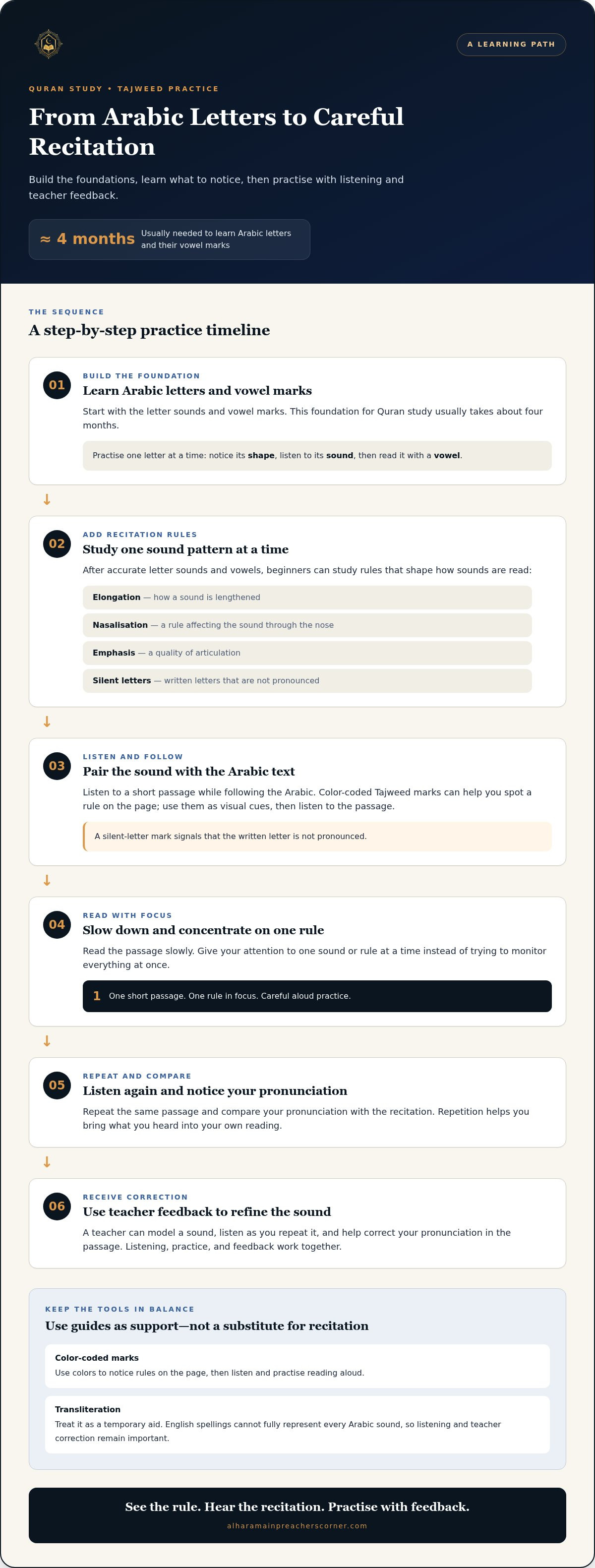
Transliteration can help connect Arabic script with familiar sounds. Use it as a temporary aid, not a replacement for learning Arabic or reciting it with a qualified teacher. English spellings cannot fully represent how every Arabic sound is formed, so listening and correction remain important.
Begin with the Arabic letters and their vowel marks. Learning these foundations for Quran study usually takes about four months. Practise one letter at a time: notice its shape, listen to its sound, then read it with a vowel. A teacher can help you distinguish letters that may seem similar to a new learner.
Which Tajweed rules should beginners learn first? Start with accurate letter sounds and vowel marks, then study rules that shape how sounds are read, including elongation, nasalisation, emphasis, and silent letters. A teacher can introduce each rule with a short example from the text.
Color-coded Tajweed marks can make rules easier to spot on the page. A color may draw your attention to elongation or nasalisation, while a silent-letter mark signals that the written letter is not pronounced. Use the colors as visual cues, then listen to the passage and practise reading it aloud.
A practical study routine keeps these tools in balance. First, listen to a short passage while following the Arabic text. Next, read it slowly and focus on one rule at a time. Repeat the passage and compare your pronunciation with the recitation. A guide helps you see, careful listening helps you hear, and teacher feedback helps you correct.
For a deeper foundation, learn the letters and vowels before relying on transliteration. Then bring a short passage to a lesson and ask the teacher to explain its marks and pronunciation. Quran with Tajweed classes offer guided practice for learners who want support as they develop their recitation.
In-person Quran and Arabic classes may be held at mosques, Islamic centers, and schools. The app provides Quran Tafsir in Arabic. Online Quran teaching and Arabic learning courses may be taught individually or in groups.
Correct articulation and Quran recitation
Correct articulation helps preserve the sounds and qualities of Quranic recitation. Develop it by listening, reading aloud, and adjusting your pronunciation with careful feedback.
Quran 2:121 describes believers as those who recite the Book as it should be recited. Slow, attentive recitation can help readers focus on pronunciation. Together, these verses offer a clear direction: give each word attention, and avoid rushing through a passage. Slow reading also gives you time to notice where a sound begins, how it continues, and where it ends.
Listen, recite, and refine
Start with a short passage you can revisit instead of rushing through a long section. Listen once while following the Arabic text, then recite the same passage aloud. Notice any letter that feels difficult, such as a sound you tend to replace with a more familiar one. Repeat the word carefully, then read it again in its phrase. A teacher can hear distinctions that may be hard to judge alone and demonstrate the sound.
Use this practice sequence for one passage:
- Listen: Follow the Arabic text and notice how the reciter shapes each word.
- Read aloud: Recite slowly, keeping your attention on clear letters and vowel sounds.
- Pause: Mark a word or sound that feels uncertain, rather than repeating the whole passage carelessly.
- Repeat: Practise the marked phrase, then read it again as part of the passage.
Regular home practice gives a learner more chances to apply corrections between lessons. For a child who practises consistently at home and studies for 2 hours per week, learning the basics of good recitation can take about one year. The key is a manageable routine: revisit the passage, focus on a specific correction, and return to it during the next practice session.
If a child rushes through a phrase, ask them to slow down and listen for each letter. If an adult struggles with a particular sound, practising the word before reading its full verse can make the challenge easier to identify. In both cases, precise feedback is more helpful than repeating the passage without addressing what needs adjustment.
Keep a short practice note with the passage and one correction to remember. At your next reading, review the note before beginning and focus on the words that need attention. This steady pattern helps recitation develop through listening, deliberate practice, and attentive Quran reading.
Definition and purpose of Tajweed
Tajweed is the practice of reciting Quranic Arabic with attention to each letter’s sound and qualities. It guides how letters are articulated, sounds connect, and recitation flows. For example, a learner considers whether a sound is prolonged, nasal, or pronounced clearly. These details support careful reading instead of a rushed sequence of words.
The aim is to recite the Quran with precision and attentiveness. Tajweed gives learners a framework for noticing how a letter should sound within a word. The written Arabic letter is the starting point, while its position beside other letters affects how a rule is applied. Listening and reciting aloud connect that written guidance with sound.
Quran 25:32 describes the Quran as having been spaced distinctly. For a learner, this idea can be reflected in measured recitation: attend to one phrase, give its sounds room, then continue thoughtfully. Tajweed supports this care through principles that guide pronunciation, rather than through decoration or a particular melody. The aim is clarity and faithful attention to the words.
Several features make Tajweed easier to understand. As you read, consider each of these questions:
- Articulation: Where does the letter’s sound form, and can you distinguish it from a similar sound?
- Vowel marks: Which short vowel appears, and how does it change the sound of the letter?
- Sound qualities: Does a rule call for nasalisation, emphasis, or a clear pronunciation?
- Connection: How does the letter sound when it joins the next letter in a word?
Memorizing rule names alone is not enough. You may recognize a term on the page yet still need to hear how it applies in recitation. Choose a word, listen to a careful example, and repeat it while noticing the relevant sound. Then read the whole phrase so the rule becomes part of the passage, not an isolated exercise.
Tajweed also helps learners approach recitation with deliberate care. You do not need to rush through every rule at once. Begin with clear letters and familiar vowel marks, then apply one new principle during a short reading. After a teacher’s demonstration, repeat the phrase and listen for the specific sound that changed. Step-by-step practice brings meaning, sound, and attentive reading together.
Which online Quran platforms include color-coded Tajweed rules and audio recitation?
Look for an online Quran reader that combines color-coded Arabic text with recitation audio. These tools support different parts of practice: colors help you notice a rule, while listening lets you hear how it sounds. Some readers also let you repeat audio by verse or section, making it easier to revisit a passage attentively.
Color coding can mark rules such as elongation, nasalisation, emphasis, and silent letters. It is a visual guide, not a substitute for understanding a rule or hearing it applied. If a mark draws your attention to elongation, listen to the corresponding phrase and notice how the reciter sustains the sound. Then read the phrase aloud, following the same mark.
Audio controls are most useful for focused repetition. If a verse contains a sound you’re learning, replay it while following the Arabic text, then recite it yourself. Repeating a section can help you hear how that sound works across connected verses. Return to the same passage after practising instead of switching examples before you recognize the rule.
When comparing readers, use these practical checks:
- Text display: Confirm that Tajweed colors appear directly alongside the Arabic words.
- Rule key: Find an explanation showing what the colors represent, including silent letters or nasalisation.
- Audio controls: Look for options to repeat a verse or section without restarting the entire reading.
- Reading flow: Open a passage and check that the text remains easy to follow while audio plays.
- Study support: See whether the reader includes Arabic Tafsir when you want to explore explanation alongside recitation.
Try one short passage before settling into a routine. First, identify a colored mark and read its explanation. Next, play the matching audio and follow the word on screen. Then repeat the verse and recite it yourself, focusing on that rule. This sequence turns a visual cue into listening practice and then active recitation.
Use digital features as practice aids, not as a complete measure of pronunciation. Color can point out a rule and audio can model its sound, but a qualified teacher can listen to your recitation and correct what a screen cannot assess. Replay a verse for practice, then bring a question about its marked rule to a lesson.
If you’d like personal guidance applying these rules while reciting, begin guided Quran Tajweed learning.
Al-Haramain Preacher's Corner: Quran with Tajweed
Al-Haramain Preacher's Corner offers live online Quran with Tajweed classes for learners seeking guided recitation practice. In one-to-one lessons, a teacher can listen closely, explain a rule, and help you practise it in context. Classes are taught by qualified instructors and certified scholars from Madinah, with male and female teachers.
Choose these classes when you want personal guidance with pronunciation, Tajweed rules, or a steady learning routine. Families can also explore the Kids Tarbiyah Course, while Islamic Studies, Memorization (Hifz), and Tafsir of the Holy Quran support other areas of learning.
To take the next step in your Quran learning, contact Al-Haramain Preacher's Corner or visit its website.
Let Your Recitation Grow With Purpose
Begin with a clear intention: choose what you want to strengthen, whether careful pronunciation, a steadier reading rhythm, or a child’s confidence in Quran learning. Bring that intention to your practice and let each lesson build on the last. Learning online Quran with Tajweed can become a meaningful part of your routine when you practise patiently and keep refining your recitation.
Al-Haramain Preacher's Corner offers Quran with Tajweed, the Kids Tarbiyah Course, and Islamic Studies. These learning paths can support different needs within a household while keeping Quran study connected to faith and daily life.
When you’re ready to take a thoughtful next step, contact Al-Haramain Preacher's Corner to discuss your learning goals. May your recitation continue to deepen with care, understanding, and sincerity.
Frequently Asked Questions
How Long Does It Take?
Learning Arabic letters and their vowels for Quran study usually takes about four months. A child’s Tajweed lessons typically take 7-10 months after that foundation. With regular home practice and two hours of study each week, a child can learn the basics of good recitation in about one year. These are different milestones: building reading foundations, studying Tajweed, and developing basic recitation skills.
How to Learn Tajweed and Teach Children?
Learn alongside your child by listening to a short passage together, then taking turns reading it aloud. Choose one point to practise, such as a letter sound or a pause, and let your child repeat it after hearing a clear example. Keep practice calm and attentive rather than treating every correction like a test. A teacher can guide pronunciation, and your shared routine can help your child revisit lessons at home.
What is Tajweed?
Tajweed is the discipline of reciting the Quran with care for the sounds and qualities of its letters. It guides how Arabic letters are pronounced and shapes recitation. A learner studies a rule, hears it in a passage, then applies it while reading. Tajweed is not simply a style of singing; it supports careful, attentive recitation of the Quran’s words.
What websites offer an online Quran with Tajweed?
Al-Haramain Preacher's Corner offers live online Quran with Tajweed classes. Consider whether you need guided instruction or a reading aid: an instructor can listen to your recitation and respond, while a digital reader supports independent practice. Choose the support that fits your current goal. Live lessons give you space to recite and receive direct guidance.
How can I learn Tajweed online step by step?
Start by choosing a short passage and one pronunciation point to focus on. Listen to a recitation while following the Arabic text, then read the passage aloud and note where you hesitate. Practise that phrase again, focusing on the sound or rule. At your next lesson, recite it for your teacher and apply the correction. This gives each practice session a clear purpose.
How can I find a qualified online Quran teacher with Tajweed certification?
Look for a teacher with relevant Quranic knowledge who can demonstrate Tajweed and give specific feedback on your recitation. Ask what their certification represents and how lessons assess pronunciation in practice. Al-Haramain Preacher's Corner teaches through qualified instructors and certified scholars from Madinah, with male and female teachers. Notice whether the explanations are clear and the corrections help you understand what to practise next.
